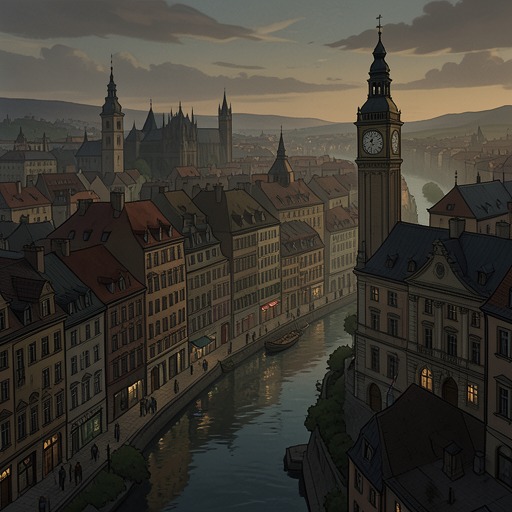
Place Saint-Michel
A Moveable FeastPlace Saint-Michel is remembered through an unnamed café that offers warmth and a place to write on a cold, rain-swept day in Paris. Rather than describing the square as a landmark in isolation, the narrative gives it meaning as the destination of a walk and the setting for a small but consequential return to work.
Setting and Approach
The visit comes with the first cold rains of winter, when the streets have turned wet and dark and familiar shopfronts are closed. The narrator has a room on the top floor of a hotel where he works, but heating it means buying kindling, fire-starting sticks, and wood. Before spending that money, he looks up at the roof in the rain to see whether any chimneys are smoking; seeing none, he worries that his own chimney might not draw, filling the room with smoke and wasting both fuel and money. He walks on instead.
His route makes the café a destination reached through the city’s ordinary geography. After passing the Lycée Henri Quatre, the church of St.-Étienne-du-Mont, and the Place du Panthéon, he takes shelter from the wind, then continues along Boulevard Saint-Michel, past the Cluny and Boulevard Saint-Germain, to a café he knows on Place Saint-Michel. The account links the square not to a grand urban panorama but to a remembered path shaped by weather, work, and the cost of keeping warm.
A Café That Makes Work Possible
The café is described as pleasant, warm, clean, and friendly. The narrator hangs his old waterproof coat on the rack to dry, puts his worn felt hat above the bench, orders a café au lait, and takes a notebook and pencil from his coat pocket. These practical actions establish the room as a temporary working place: he can settle in, dry off, and begin writing without first making a fire in his cold hotel room.
The writing draws on a memory of Michigan. Because the day is wild, cold, and blowing, the weather in the story becomes wild, cold, and blowing too. The narrator describes this transfer of feeling and setting as transplanting: a story can be written more effectively in one place than another, and the same principle may apply to people as to growing things. Place Saint-Michel thus becomes more than shelter; it is where the weather outside helps him enter a different landscape on the page.
Drink, Contrast, and the Scene’s Human Detail
The story’s boys are drinking, which makes the narrator thirsty. He orders a rum St. James, finds the Martinique rum especially welcome on the cold day, and continues writing, feeling its warmth through his body and spirit. The sequence binds the act of composition to the conditions of the café: writing prompts the drink, and the drink sustains the writer at his notebook.
The scene also introduces a young woman who enters and sits alone at a table near the window. Her rain-fresh skin and sharply cut black hair are rendered in a vivid visual impression, adding a moment of attention to the working scene without displacing it. Elsewhere in the same winter recollection, the Café des Amateurs is presented as a crowded, badly run establishment associated with constant drunkenness and unpleasant smells. That neighboring example sharpens the distinction: the café on Place Saint-Michel is not merely somewhere to escape the rain, but a clean and congenial alternative in a city whose cafés offer very different conditions.
Place in the Book’s Paris
The episode presents Paris through movement between streets, rooms, and cafés rather than through a fixed inventory of monuments. Place Saint-Michel matters because the narrator knows a good café there and can reach it on foot when the cold makes his room difficult to use. The square becomes a point in a working map of the city, where the expense and uncertainty of heating a room give way to warmth, a familiar drink, and a notebook opened on the table.
Its significance is also literary. In the café, the immediate weather is carried into a remembered Michigan setting, while the physical ease of the room allows the narrator to keep writing. The passage makes the place part of a larger account of how daily circumstances shape creative work: a route chosen to avoid wasting fuel ends at a table where a story can continue.